


Tuscany by Vespa
The first day of our Tuscany by Vespa tour was still dedicated to preparations. Our Tour Guide (TG), however, had already completed his duties with flying colours. After carefully checking all seven Vespas, he parked them neatly in the shade, side by side like a swarm of little red wasps, keeping them safely away from the scorching Tuscan sun. While our guests gradually arrived from all corners of the world, our TG also prepared his little “work of art” – a flipchart with a sketch of the route planned for the days ahead. Once everyone had arrived, we gathered in the pleasantly air-conditioned meeting room. And on this particular day, the air conditioning was definitely our friend – outside, temperatures were soaring above 35°C. After a short welcome and introductions, we went through the plans for the coming days, the route ahead and, of course, some important safety guidelines. Because even though our Vespas are small and playful, the roads of Tuscany still deserve our full respect. And then came the moment we had all been waiting for – meeting our red Vespa GTS 300s. We checked the scooters, got familiar with our machines and went through the final questions before heading out on our first kilometres the following morning. We finished the day with an excellent dinner, giving everyone another opportunity to get to know their fellow riders and get into the spirit of the adventure ahead. The Vespas are ready, the route is planned, the safety briefing is done – and Tuscany is waiting for us. Tomorrow, we finally ride. Sun-drenched Tuscany, seven red Vespas and our first kilometres ahead. Andiamo!
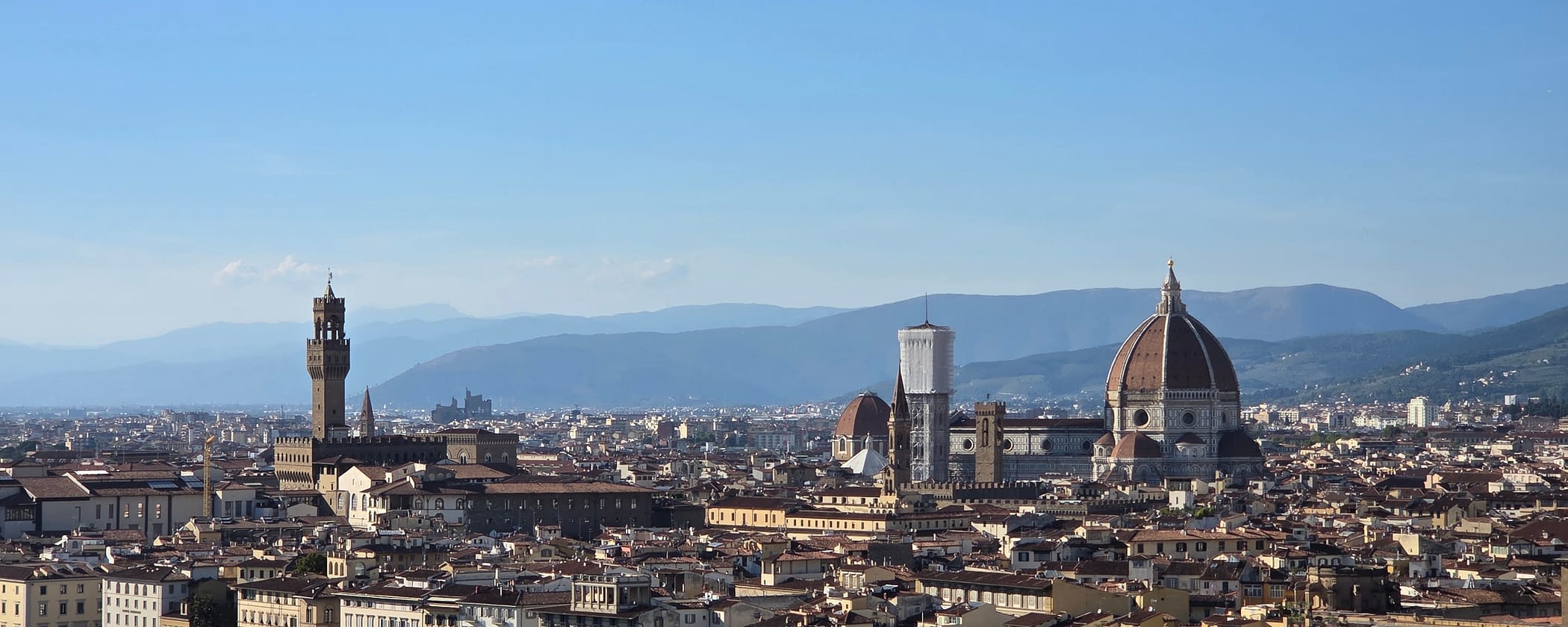
During our fantastic welcome dinner, we all agreed on one thing – the weather was simply more than perfect. Sunny, stable and seriously hot. And since we were well aware that the Tuscan afternoon sun could be quite intense on our Vespas, we decided to make a small adjustment to the schedule. We met at our motorcycles half an hour earlier than usual. After the morning briefing, we turned the keys, fired up our seven red Vespa GTS 300s and headed south towards Siena. Our first kilometres took us into the heart of the Chianti region, and before long we stopped for our first Italian coffee in the town of Greve in Chianti. Greve is considered one of the gateways to the Chianti region, and its main square, Piazza Matteotti, has been an important local market place since medieval times. Coffee, a short break, and back into the saddle. Along the way we were faced with a few minor technical challenges, but nothing that seven determined Vespa riders could not handle. Italian machinery simply likes a little attention from time to time. :-) After a short pause, we were ready to continue, and Siena was waiting for us. And we had been looking forward to it. Siena is one of Italy's most beautiful medieval cities, and its historic centre has been a UNESCO World Heritage Site since 1995. The city is built across three hills, with its streets eventually leading to the famous Piazza del Campo, one of Europe's most distinctive squares. Its unusual shell-like shape is no coincidence – the square is divided into nine sections, commemorating the Council of Nine, which governed Siena at the end of the 13th century. And of course, Siena is also the home of the legendary Palio di Siena. Twice a year, on 2 July and 16 August, Piazza del Campo is transformed into a horse-racing arena. A layer of earth is brought in to create the racing track, where horses representing the city's historic contrade compete in one of the world's most famous and spectacular horse races. After an excellent lunch, we also took some time to explore the historic centre and simply enjoy the atmosphere of this remarkable city. Then it was time to head back. And while the morning had already been hot, the afternoon became seriously hot. Temperatures reached an incredible 37°C in the shade. Fortunately, beautiful Tuscan roads and several pleasant stops were still waiting for us. Our first stop was an afternoon coffee in Gaiole in Chianti. This small town has almost cult status in the cycling world. It was here, in 1997, that L'Eroica was born – a cycling event created by Giancarlo Brocci as a tribute to classic cycling and its heroic era. The first edition attracted just 92 participants and took riders along challenging roads through the beautiful Tuscan countryside. One of the great charms of L'Eroica is its use of strade bianche – the famous white gravel roads, which have become an essential part of the event's identity. While our Vespas stayed on paved roads, the idea of preserving these old roads and the spirit of historic cycling remains one of the central principles of L'Eroica. What began as a small event in Gaiole has since grown into a worldwide cycling movement. After a few more kilometres, we slowly approached Florence. One final fuel stop for our little red bees, followed by a quick preparation for another highlight of the day – a fantastic Italian dinner at Ristorante Terrazze Michelangelo. After dinner, we headed up to Piazzale Michelangelo. And there, one of those views that make travelling to Tuscany worthwhile opened up before us. Below us lay Florence at night – the illuminated Duomo, towers, palaces and the River Arno winding its way through the city. After a full day in the saddle, we enjoyed the moment at a much slower pace. Our first day on the Vespas was over. Siena, Chianti, 37°C, a few technical challenges, hundreds of curves, great food and Florence by night. If this was only the first day, we were already very curious to see what the next ones would bring. Buona notte, Firenze. Domani si riparte! 🇮🇹
After yesterday's demanding and seriously hot day, when we headed south all the way to Siena, today we decided to stick to our original 8:00 start time. This time, however, we pointed our Vespas in the opposite direction – north. And since we were a slightly smaller group today, our little red machines were quickly lined up and ready to go. Our first stop was the Mugello Circuit – a place that every true motorsport fan, and especially every two-wheeled enthusiast, simply has to visit. Mugello has a very special place in Italian motorsport. The racing history of the region goes back much further than the modern circuit itself. The first Mugello road race took place as early as 1914, on a legendary 66-kilometre road circuit winding through the Apennines. Over the years, the region became the stage for major battles on both four and two wheels. The modern Mugello Circuit has been hosting the Italian Motorcycle Grand Prix since 1976, and 2026 marks the 50th anniversary of that first Grand Prix. Over the decades, legends such as Giacomo Agostini, Barry Sheene, Kenny Roberts, Freddie Spencer, Valentino Rossi and many others have written their names into Mugello's history. The 5.245-kilometre circuit has become one of the most loved tracks among riders and fans alike. We were not planning to chase lap records, of course. Our Vespa GTS 300s had their own version of an Italian racing adventure waiting for them. Via Passo del Giogo at 882 metres, we continued further north. The road gradually took us into smaller mountain villages, and in Conaile we had planned our first proper coffee stop. But Italy had other plans. The café was closed. So our first serious dose of caffeine and a little something to eat had to wait until Palazzuolo sul Senio, where we finally parked our Vespas and enjoyed a well-deserved break. After a short rest, the part of the day we had been looking forward to most was waiting for us. Passo del Muraglione. For motorcyclists, this name is almost magical. Curves, elevation changes, beautiful scenery and an atmosphere that simply belongs to Italian motorcycle culture. And although we were riding Vespas rather than MotoGP machines, Muraglione gave us exactly what we had come to Tuscany for – beautiful roads, countless corners and pure riding enjoyment. The history of the pass is fascinating as well. The road across the Apennines was completed in 1836, and a massive stone wall was built at the summit to protect travellers from the strong winds blowing along the ridge. This muraglione, meaning “big wall”, eventually gave the pass its name. The road was an important connection between Florence and Romagna, and also linked the Tyrrhenian Sea with the Adriatic. Today, Muraglione is particularly famous among motorcyclists. And we simply enjoyed every single curve. Once we reached the summit, we treated ourselves to a longer break and some refreshments. The place still has that unmistakable motorcycle atmosphere – tables, coffee, conversations between riders and countless stories written on two wheels. Historical photographs of motorsport and racing in the mountains decorate the local café, reminding us that these roads were already attracting racers, enthusiasts and adventurers long before we arrived. And there was another reason to slow down and look around. We were riding through the Foreste Casentinesi, Monte Falterona and Campigna National Park, one of the most important forested areas of the Italian Apennines. The region has a long history, with ancient settlements, pilgrimage routes crossing the mountains towards Rome and centuries of monastic tradition, particularly around Camaldoli. After a few more kilometres, we started thinking about just three things: Shade. Water. Swimming pool. But before reaching the hotel, one more little stop was waiting for us. Our guide had prepared a traditional Boot Beer. For those unfamiliar with this motorcycle tradition, it is a simple but much-loved ritual after a day's ride. Riders enjoy a refreshing drink while still wearing their motorcycle boots – it can be a beer, a radler or simply a non-alcoholic refreshment – together with a small snack and, most importantly, some time to share the best moments of the day. And that was exactly what our Boot Beer was all about. The curves. Muraglione. The Vespas. The little adventures along the way. And, of course, a friendly discussion about who had ridden “the best” today. :-) Then there was nothing left to discuss. Splash! The hotel swimming pool welcomed us with open arms, and after such a hot day in the saddle, the cool water was probably the best possible way to finish the ride. Now we only had to make it to dinner. Another excellent hotel dinner was waiting for us, along with the opportunity to look back on a day that had everything we could have hoped for from Tuscany by Vespa. Mountain roads, legendary passes, motorsport history, beautiful nature, a little Italian chaos and plenty of joy on two wheels. Exactly how a day on a Vespa in Tuscany should be. Buona sera e… alla prossima curva!
After the previous two riding days, we deliberately planned a shorter day today – around 140 kilometres, roughly 40 kilometres less than the previous two days. The reason was simple: the weather forecast was predicting a change, with heavy rain and thunderstorms on the way. In the end, the storm did catch us, but fortunately we managed to make it quite an experience. We started the morning on the familiar and wonderfully twisty SS222 through the Chianti region. We passed through Greve without stopping – after a full hotel breakfast, nobody was exactly desperate for food. Our first real coffee and a slice of cake came in beautiful Castellina in Chianti, which turned out to be a perfect place for a short morning break. From there, we continued along increasingly scenic and winding roads towards one of Tuscany's most famous towns – San Gimignano, often nicknamed the “Manhattan of the Middle Ages.” And there is a very good reason for that name. During the Middle Ages, wealthy families built tall fortified towers as symbols of their wealth, influence and power. At the height of its prosperity, San Gimignano had around 72 towers. Today, 14 of them still dominate the skyline, creating one of the most distinctive panoramas in Tuscany. We parked the Vespas and set off on foot to explore the historic centre. Under the warm Tuscan sun, the narrow medieval streets, stone buildings and lively squares were exactly what we had hoped for. Lunch was another difficult decision – omelette, pasta, pizza or gnocchi? In Tuscany, even choosing lunch can become a serious task. At Piazza della Cisterna, we stopped for the obligatory group photo. But while everyone else went for lunch, the guide quietly disappeared for a moment. A little later, he returned with a printed copy of the group photograph for every guest. A simple surprise, but one that immediately turned into a great souvenir from the tour. Then came the small adventure of the day. When we got back to the Vespas, one of our guests suddenly realised that the motorcycle key was missing. We searched around the restaurant table, checked pockets and tried to remember where it might have disappeared. Finally, we reached the Vespas. And there it was. The key was still sitting in the lock of the top case. Even in the age of keyless systems, apparently there are still some traditions worth preserving. The relief was considerable. We continued towards Certaldo and Montespertoli, heading back towards Florence. A bridge reconstruction forced us into a roughly 10-kilometre detour. It made the route longer, but in true Italian fashion, the unplanned roads turned out to be more interesting than the original ones. About 35 kilometres before our planned return to the hotel, however, we realised that there was no way we were going to outrun the approaching storm. We pulled the Vespas under some trees and waited. Then came another beautiful example of Italian hospitality. The owner of a small T-shirt printing company nearby invited our entire group into his little workshop so we could shelter from the rain. He kept apologising that he wasn't used to having guests and had nothing to offer us. We assured him that he had already given us exactly what we needed. A dry roof over our heads was more than we could have hoped for. After about 30 minutes, the storm weakened. We thanked our unexpected host, climbed back onto the Vespas and continued towards Florence through light rain and drizzle. The forecast was still threatening another wave of storms, so we decided not to take any chances. Eventually, we made it safely back to the hotel. Another day on the Vespas, another story to remember – and hopefully another tasty dinner waiting for us. Not every day goes according to plan. But very often, those are precisely the days we remember the longest. Buona sera, Toscana. And grazie for the rain!
After yesterday’s rainy return to the hotel, the morning brought us a forecast that left little room for optimism. Heavy thunderstorms throughout the day, strong gusts of wind and lightning – definitely not the combination we wanted to face on an 80-kilometre ride around Florence. This time, common sense won over adventure. For safety reasons, we decided to skip the planned ride and leave our red Vespas resting safely in the hotel car park. After three intense riding days, we finally allowed ourselves a slower morning. No motorcycle gear, no checking the weather forecast every five minutes and no wondering whether we would manage to stay ahead of the next storm. Just a chance to slow down a little. At 10:00, we met at reception, where our guide was already waiting for us. And since today’s programme was planned without the Vespas, another small logistical challenge began – trying to conjure up a taxi, or rather suitable transportation for our entire group. Eventually, we managed to make it work. Our destination for the day was a typical Tuscan estate where, for centuries, the cultivation of grapes and olives has gone hand in hand with the production of wine and olive oil. And this was no ordinary place. The history of Travignoli reaches far back into the past. The tradition of growing vines in this area is connected with the Etruscans, who were cultivating grapes here as early as around 500 BC. Its long history and continuity have made Travignoli one of approximately 150 of Italy’s oldest businesses. Today, we had the opportunity to discover not only how the products are made, but also the story of the land that makes the Chianti region so distinctive. We walked through the olive groves and vineyards, visited the production areas and gradually discovered the processes behind both wine and olive oil production. Afterwards, we sat down together at the table, where a small selection of local delicacies awaited us, accompanied by an introduction to the history of the estate, the cultivation of olives and grapes and, of course, the wine from the Chianti region with its protected regional designation of origin. The atmosphere was completely different from what we had experienced during the previous days. Quiet, refined and quite literally steeped in history. The air was filled with the aromas of freshly processed grapes and olive oil, which we tasted on fresh Italian bread. Outside the windows, meanwhile, the rain continued to drum steadily. And somehow, the sound of those raindrops against the window frames only confirmed that leaving the Vespas safely at the hotel had been exactly the right decision. Instead of the sound of engines, today we listened to stories, tasted Tuscany and, for a while, stepped into a world where time is measured not by kilometres ridden, but by the age of vineyards and the centuries-old olive trees. After approximately two hours, we said goodbye to our hosts and waited a little while for the taxi that would take us back to our cosy hotel, Villa Neroli. Back to the warmth. Back to the dry. And, most importantly, back to peace and quiet. Before dinner, everyone has time to relax in their own way. Perhaps in the wellness centre with a massage, perhaps with a good book, or simply somewhere in the quiet of the room, enjoying a short afternoon nap. After three days on the Vespas, we have certainly earned it. And this evening, another pleasant change of scenery awaits us – a great dinner outside the hotel. Today simply reminded us of one of the basic rules of travelling: sometimes the best plan is knowing when to change the plan. And in Tuscany, even a rainy day can end with a glass of good wine, fresh bread and the aroma of olive oil. A domani, Toscana. Tomorrow, hopefully, back on the Vespa.
After a rainy day and an even rainier night, we woke up to a cold and wet Tuscany. The forecast was not exactly encouraging, but our plan for the week was clear – today was our final riding day, and our destination was Arezzo. Shortly after eight o’clock, we met beside our Vespas. After the overnight rain, they were not exactly looking their freshest, but our helpful guide carefully wiped them all dry. One last check, helmets on, and we were ready to go. We left the unique, but also busy, Florence behind and headed into the mountains. Our first destination of the day was Passo della Consuma, at an altitude of 1,057 metres. The approximately 25 kilometres of road across this mountain pass are among the best things a motorcyclist can experience in Tuscany. Countless curves, good-quality asphalt and beautiful scenery – no wonder the pass attracts riders from all around the region, especially at weekends. Sometimes, it seems that local motorcyclists turn it into their own little race track. Today, however, conditions were quite different. The roads were wet after the rain, the air at more than 1,000 metres was distinctly chilly, and our little Vespas deserved a little extra respect. Nevertheless, we thoroughly enjoyed those final mountain curves. After Consuma, we had planned to stop somewhere for refreshments. But Friday morning is apparently a perfect time for a rest day in Italy – everything we tried along the way was closed. No cappuccino, no brioche. Tuscany simply encouraged us to keep moving. So we continued directly towards Arezzo. Before exploring the city, however, we had to take care of one of the most important things on any motorcycle trip – finding a safe place for our Vespas. Once all of them were securely parked, we could finally set off on foot to discover the historic centre. Arezzo is one of Tuscany’s oldest cities. In Etruscan times, it belonged to the so-called League of Twelve, an important alliance of Etruscan city-states. Today, the city has a very different kind of reputation – it is one of Italy’s important centres of gold jewellery manufacturing. Huge quantities of gold are processed here every month, making Arezzo a rather tempting destination for anyone looking for a small golden gift for someone special. But history came first. We walked through the old town from one church to another, gradually making our way to the magnificent Piazza Grande. The square is surrounded by medieval houses, palaces and towers, with the Romanesque apse of Santa Maria della Pieve forming one of its most striking features. It does not take long to understand why Arezzo is such a fascinating destination. The city regularly brings its medieval past back to life during the famous Giostra del Saracino – a historic jousting tournament in which competitors dressed in traditional costumes compete on horseback. For a moment, Arezzo becomes a genuine journey through time. Arezzo also has its own chapter in cinematic history. Roberto Benigni filmed several scenes of his Oscar-winning movie Life Is Beautiful here. Some corners of the city may therefore look familiar even to those who have never visited Arezzo before. After a delicious lunch on Piazza Grande, everyone had about an hour of free time. Some continued exploring the historic centre, while others took the opportunity to do a little shopping. And in a city famous for gold jewellery, there was certainly no shortage of temptation. After meeting up again, we took one more short walk to the basilica, which we also had the opportunity to visit inside. Then it was time to return to our Vespas. We climbed aboard and headed back towards Florence. Along the way, we made one more refreshment stop, refuelled in Florence and finally returned to the hotel together as one group. The final kilometres were behind us. And with them, the final riding day of our Tuscany by Scooter tour. In the evening, our final dinner together awaited us. But before heading out, our guide had prepared a surprise. He showed us a video montage from our entire tour, gave each participant a small souvenir and had one more special gift prepared for Vincent – a T-shirt celebrating his milestone of completing his fifth tour. Then we all headed out for our final dinner. And it was exactly what it should have been. Excellent food, wonderful flavours, but above all, a fantastic atmosphere. Around the table, stories from the tour we had just completed mixed with stories from the past. We remembered the curves, the rain, the sunshine, the little adventures, the Vespa moments and, of course, everything else that had happened during the week. And then came the tour evaluation. Fortunately, there was no need to wait for a jury to announce the result. Tuscany by Scooter had done its job. Perhaps we did not cover thousands of kilometres during the week. But over those 749 kilometres, we experienced a large part of what makes Tuscany so special – historic towns, vineyards, olive groves, mountain passes, great food, rain, sunshine, a little adventure and, above all, shared experiences. And tomorrow? The Vespas will stay parked. But our week is not quite over yet. Grazie, Toscana. A domani!